
Creatine Monohydrate Benefits for Muscle & Brain | Bullpen
Creatine Monohydrate Benefits: Strength, Muscle, Recovery and Brain Performance
Creatine Monohydrate Benefits: Strength, Muscle, Recovery and Brain Performance
Creatine has been part of serious strength training for decades, but its value is not based on gym folklore. Creatine monohydrate is one of the most extensively researched ingredients in sports nutrition, with evidence supporting its ability to increase muscle creatine stores, improve repeated high-intensity performance and enhance the adaptations produced by resistance training. Research on creatine and the brain is also growing, making it increasingly relevant to people interested in focus, mental performance and nootropics - not only bodybuilders.
That does not mean creatine is a shortcut. It does not replace hard training, sufficient protein, quality sleep or a well-built program. What it can do is strengthen the energy system behind hard, repeated efforts. Over time, that may help you complete more productive work and get more from the training you are already doing.
What Is Creatine Monohydrate?
Creatine is a naturally occurring compound made from amino acids. Your body produces it, and you also obtain smaller amounts from foods such as meat and fish. Most of the creatine in the body is stored in skeletal muscle as free creatine and phosphocreatine, while smaller amounts are found in tissues with high energy demands, including the brain.
“Creatine monohydrate” describes creatine bound to one molecule of water. It is the benchmark form used in the overwhelming majority of performance, dosing and long-term safety research. Newer forms may be marketed as more advanced, but current evidence has not established them as more effective than properly dosed creatine monohydrate (Kreider et al., 2017; Antonio et al., 2021).
How Creatine Supports Strength and High-Intensity Training
Muscle contraction runs on adenosine triphosphate, or ATP. Your muscles keep only a limited amount of immediately available ATP, so hard efforts quickly require ATP to be regenerated. The phosphocreatine system helps accomplish this by donating a phosphate group to ADP, rapidly rebuilding ATP.
Supplementing with creatine increases the amount of creatine and phosphocreatine stored in muscle. That expanded reserve is especially relevant during short, intense and repeated efforts such as heavy sets, sprint intervals, explosive jumps, strongman events and repeated bouts of high-output conditioning.
Creatine will not make every rep feel effortless. Its effect is usually more practical than dramatic: an additional rep, slightly better power retention, more total quality work or less drop-off across repeated sets. Those small advantages can compound across weeks and months of training.
Creatine for Muscle Growth: A Training Amplifier, Not a Steroid
Creatine is not an anabolic steroid, hormone or stimulant. Its muscle-building value comes primarily from helping support better training and, in many studies, improving gains in lean mass when combined with resistance exercise.
There are two important parts to this effect:
1. Early cell hydration. Creatine draws water into muscle cells. Some people notice an increase in body weight during the first days or weeks of use. This is not fat gain; much of the early change reflects water stored within muscle.
2. Better long-term training output. If greater phosphocreatine availability helps you perform more high-quality work, creatine can indirectly strengthen the training signal that drives adaptation.
Creatine should therefore be viewed as a force multiplier for consistent training. The stronger your program, nutrition and recovery habits are, the more useful that multiplier can become.
Does Creatine Help Recovery?
Creatine is often described as a recovery supplement, but the most defensible claim is that it supports rapid energy availability and repeated performance. Some studies have reported improvements in markers related to exercise recovery, muscle damage or glycogen restoration, while other findings are mixed.
For lifters, the most reliable recovery-related benefit may be the ability to preserve performance across hard sets and training sessions. Creatine does not replace sleep, calories, protein, rest days or sensible load management. It supports the work; it does not erase the cost of poor programming.
Creatine as a Cognitive Enhancer and Nootropic
The brain is metabolically demanding and also uses the creatine-phosphocreatine system to help buffer cellular energy. That mechanism has led researchers to study whether creatine can support memory, attention, processing speed and mental performance.
The evidence is promising, but it should be described accurately. Randomized trials and systematic reviews suggest creatine may improve some measures of memory and reasoning, yet results are not uniform across every cognitive domain or population (Rae et al., 2003; Avgerinos et al., 2018; Xu et al., 2024). Benefits may be more noticeable when baseline creatine availability is lower or when the brain is under greater energetic demand. Research has reported potentially stronger signals among vegetarians, some older adults and people dealing with sleep loss or mentally demanding conditions.
That makes creatine an interesting nootropic, but not a stimulant-like “instant focus” product. It does not produce a buzz, and one serving is unlikely to create an obvious same-day mental effect. As with muscle, creatine works by increasing tissue creatine stores over time. The best interpretation is that it may support brain energy availability and certain aspects of cognition, while the size and consistency of the effect vary from person to person.
Creatine should not be marketed as a treatment for cognitive decline, depression, traumatic brain injury or any medical condition. Those areas are being studied, but they belong in clinical care and research rather than routine supplement promises.
How Much Creatine Should You Take?
For most healthy adults, the simplest protocol is:
Take 3 to 5 grams of creatine monohydrate every day.
A 5-gram daily serving is straightforward, widely studied and easy to remember. Take it on training days and rest days because the goal is to maintain saturated creatine stores, not to create an immediate pre-workout effect.
Is a Creatine Loading Phase Necessary?
No. Loading is optional.
A traditional loading protocol uses approximately 20 to 25 grams per day, divided into four or five smaller servings, for five to seven days. After that, the user transitions to a maintenance intake of 3 to 5 grams per day. Loading fills muscle creatine stores faster, but taking 3 to 5 grams daily without loading typically reaches similar saturation after roughly three to four weeks (Antonio et al., 2021).
People who prefer simplicity can skip loading. People who want faster saturation can load, but dividing the daily amount helps reduce the chance of stomach discomfort.
When Should You Take Creatine?
Consistency matters more than exact timing. Creatine can be mixed into water, a protein shake, a carbohydrate drink or another daily beverage. Taking it near a meal may make it easier to remember, and taking it after training is convenient for many lifters, but there is no need to panic over a narrow “anabolic window.”
Creatine also does not need to be cycled. Once muscle stores are elevated, a consistent maintenance intake keeps them elevated. If supplementation stops, those stores gradually return toward baseline over several weeks.
Micronized Creatine: What It Means
Micronized creatine monohydrate has been processed into smaller particles. The clearest practical advantage is improved dispersion and mixability. Smaller particles may remain suspended more easily and feel less gritty in a drink.
Micronization should not be confused with a different form of creatine, and it does not need exaggerated absorption claims to be useful. It is still creatine monohydrate - the form supported by the deepest evidence base.
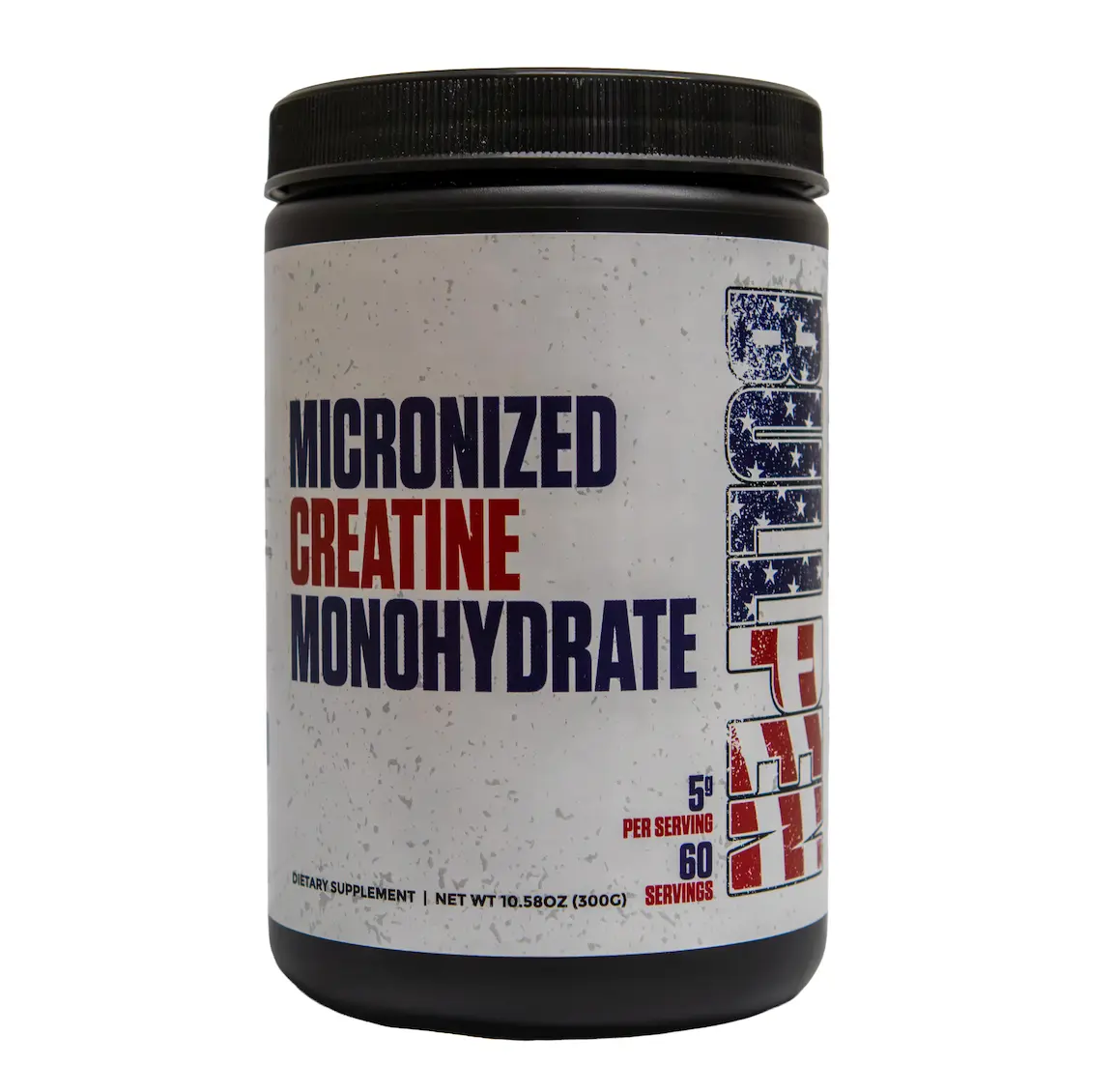
Bullpen Micronized Creatine Monohydrate provides 300 grams across 60 servings, which works out to 5 grams per serving: a simple daily dose with no complicated cycling protocol.
What Should You Expect After Starting Creatine?
With a loading phase, muscle stores can rise substantially within about a week. Without loading, the same process develops more gradually over several weeks. Some users notice fuller-looking muscles and a modest increase on the scale from intracellular water. Performance changes may appear as better repetition quality, improved repeated sprint ability or less drop-off across difficult sets.
Not everyone feels creatine working. That is normal. Creatine is not a stimulant, and its value is better judged through a training log than through sensation. Track total reps, load, sprint output, body weight and progress over time.
Creatine Safety and Common Myths
Creatine monohydrate has a strong safety record in healthy people when used at studied doses. Reviews have not found evidence that recommended creatine intake damages healthy kidneys (de Souza e Silva et al., 2019). Creatine can, however, raise blood creatinine because creatinine is a breakdown product of creatine. That may affect how a routine blood test is interpreted without indicating kidney damage.
Anyone with kidney disease, reduced kidney function, a condition affecting fluid balance or medications that may affect the kidneys should speak with a qualified clinician before supplementing. The same applies during pregnancy or nursing and for anyone under 18.
Other common concerns deserve context:
Dehydration and cramping: Controlled research does not support the idea that normal creatine use routinely causes dehydration or muscle cramps. Hydration still matters, especially in heat.
Fat gain: Creatine contains no meaningful calories and does not directly increase body fat. Early scale weight is usually water held in muscle.
Hair loss: A small study reported a change in a hormone related to hair biology, but direct evidence that creatine causes hair loss is insufficient. The claim is not established.
Bloating: Large single doses can cause stomach upset in some users. A normal 3- to 5-gram serving is generally better tolerated, and loading doses can be divided.
Creatine Monohydrate FAQs
Should I take creatine on rest days?
Yes. Daily use maintains elevated muscle creatine stores. Creatine is not only for the hour before training.
Can women take creatine?
Yes. Creatine’s energy system is not sex-specific, and research supports its use across adult populations. Women have historically been underrepresented in sports nutrition research, but there is no evidence that creatine is only for men.
Can I mix creatine with pre-workout?
Yes. Creatine and pre-workout serve different roles and can be used together. Bullpen Sauce Pre-Workout supports the training session, while daily creatine supports tissue creatine stores over time.
Does creatine need sugar to work?
No. Carbohydrate and insulin may influence creatine uptake, but creatine monohydrate is effective without adding sugar. Mix it with whatever beverage best supports consistent daily use.
Is creatine useful for people who do not lift weights?
It can be. Sprinters, field-sport athletes, combat athletes and people performing repeated high-intensity efforts may benefit. The growing cognition literature also makes creatine relevant beyond the weight room, although cognitive outcomes are less consistent than its sports-performance effects.
The Bottom Line
Creatine monohydrate has earned its place in a serious supplement routine because its mechanism is clear, its performance evidence is deep and its dosing is simple. For lifters and gym-goers, it can support strength, repeated high-intensity output and the lean-mass gains produced by resistance training. For people interested in nootropics, it may also support certain aspects of memory and cognition by strengthening the brain’s cellular energy buffer - with the important caveat that those effects are more variable.
Take 3 to 5 grams every day, train hard, eat enough protein and measure progress over months. That is the unglamorous formula that works.
Shop Bullpen Micronized Creatine Monohydrate.
References
1. Kreider RB, Kalman DS, Antonio J, et al. International Society of Sports Nutrition position stand: safety and efficacy of creatine supplementation in exercise, sport, and medicine. Journal of the International Society of Sports Nutrition. 2017;14:18. https://doi.org/10.1186/s12970-017-0173-z
2. Antonio J, Candow DG, Forbes SC, et al. Common questions and misconceptions about creatine supplementation: what does the scientific evidence really show? Journal of the International Society of Sports Nutrition. 2021;18:13. https://doi.org/10.1186/s12970-021-00412-w
3. Rae C, Digney AL, McEwan SR, Bates TC. Oral creatine monohydrate supplementation improves brain performance: a double-blind, placebo-controlled, cross-over trial. Proceedings of the Royal Society B. 2003;270(1529):2147-2150. https://doi.org/10.1098/rspb.2003.2492
4. Avgerinos KI, Spyrou N, Bougioukas KI, Kapogiannis D. Effects of creatine supplementation on cognitive function of healthy individuals: a systematic review of randomized controlled trials. Experimental Gerontology. 2018;108:166-173. https://doi.org/10.1016/j.exger.2018.04.013
5. Xu C, Bi S, Zhang W, Luo L. The effects of creatine supplementation on cognitive function in adults: a systematic review and meta-analysis. Frontiers in Nutrition. 2024;11:1424972. https://doi.org/10.3389/fnut.2024.1424972
6. Roschel H, Gualano B, Ostojic SM, Rawson ES. Creatine supplementation and brain health. Nutrients. 2021;13(2):586. https://doi.org/10.3390/nu13020586
7. de Souza e Silva A, Pertille A, Reis Barbosa CG, et al. Effects of creatine supplementation on renal function: a systematic review and meta-analysis. Journal of Renal Nutrition. 2019;29(6):480-489. https://doi.org/10.1053/j.jrn.2019.05.004
Editorial safety note: This article is educational and is not medical advice. Dietary supplements are not intended to diagnose, treat, cure or prevent disease. Readers with a medical condition, those taking medication, anyone pregnant or nursing and anyone under 18 should consult a qualified health professional before use.